One of the research focuses at IPGG SB RAS is the structure of Mesozoic deposits in the Vilyui hemisyneclise where eleven gas and gas condensate fields have been discovered, with geological reserves of natural gas totaling more than one trillion cubic meters.
The presence of regional and local mudstone caprocks with effective sealing capacity plays a key role in identification of hydrocarbon accumulations. Scientists from IPGG SB RAS have delineated spatially continuous top-seals within the Vilyui hemisyneclise.
Regional seals are thick layers of low-permeability mudstone caprocks distributed over a vast area effectively prevent the upward migration of hydrocarbons, thereby controlling the vertical hydrocarbon distribution within the entire petroliferous region, while local top-seal units perform the same function over a smaller area and are confined to a single oilfield or a group of nearby hydrocarbon accumulations.
For Upper Permian, Lower Triassic, and Lower Jurassic deposits with the most promising oil and gas potential, specialists from IPGG SB RAS have determined the thickness of mudstone formations topping gas and condensate accumulations, thus forming the regional seals. The generated geological maps will allow maximizing hydrocarbon production efficiency in the Vilyui Basin.
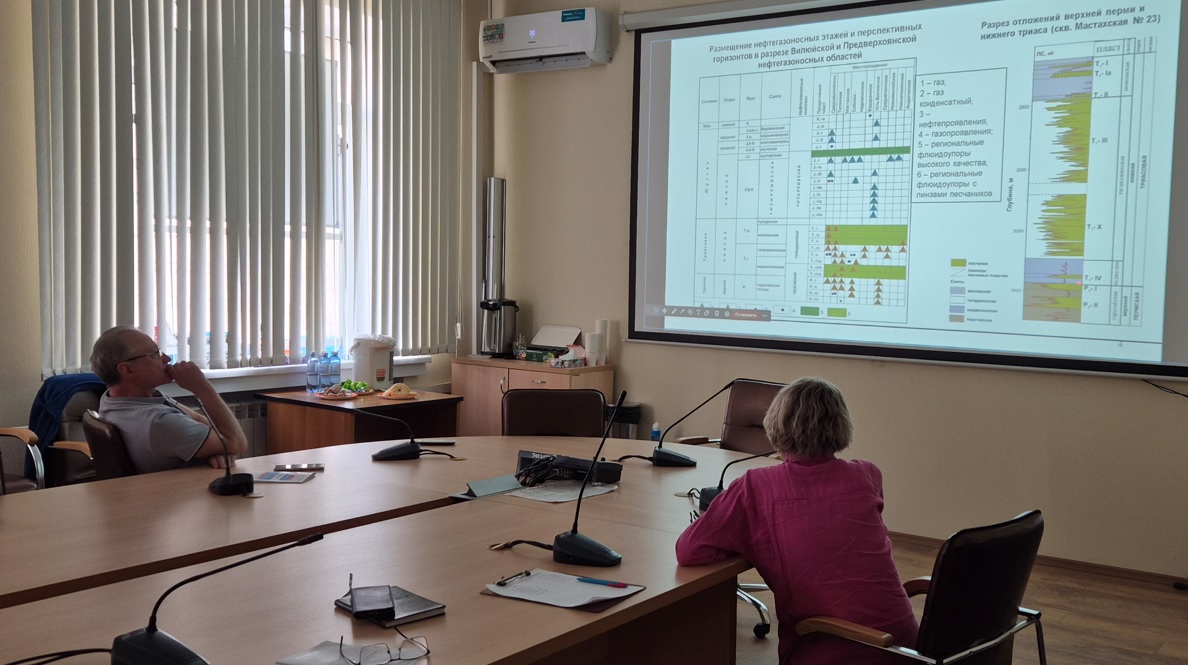
M.O. Fedorovich is giving the presentation (right); Yu.F. Filippov (left)
The research results were presented at the International Conference "Subsoil Use. Mining. Trends and Technologies for Mineral Prospecting, Exploration, and Development. Economics. Geoecology," held at the Institute in May 2026. The presentation was given by M.O. Fedorovich, PhD (geol.-mineral.), senior research scientist at the Laboratory of Petroleum Geology of the Siberian Platform at IPGG SB RAS.
Published by IPGG Press Service
Novosibirsk scientists predict new discoveries of trillions of cubic meters of gas and billions of tons of oil in Western Siberia
Transition of fiber-optic communication lines into infrastructure monitoring solutions
Ancient age of the Baikal Rift Zone hydrothermal system is confirmed by new expedition
Siberian scientists discuss collaborative projects in Asia
Russian scientists have identified promising areas for geothermal power plants in the Far East.
Scientists from Novosibirsk and Beijing met to honor the memory of Academician A.A. Trofimuk and Academician A.E. Kontorovich
Zoning of agricultural fields from electromagnetic profiling data: an integration of geophysics and soil science
Myth today, reality tomorrow: Russian scientists propose coal seam gas mining in Western Siberia by means of underground coal gasification
Novel technology developed by Novosibirsk scientists will assist in searches for oil and gas in carbonate reservoirs
Neural network algorithms developed by Russian scientists can be used for intelligent identification of nearby deposits of common geological materials
Paleontologists discovered a new species of fossil mollusk in the northern East Siberia.
V.N. Glinskikh: Operational control over the Samoylov Island research station is passing to Yakut Science Center
Deep seismic investigations of the Siberian Craton basement will help in the search for various mineral deposits in Yakutia
IPGG’s specialists in resource and energy economics presented their research findings at a conference in Irkutsk
Scientists view mudstone caprocks (seals) as primary geological indicators of hydrocarbon accumulations in the Mesozoic sedimentary cover of Vilyui Basin (Sakha Republic)
Scientists from Russia and China discussed early life on Earth spanning the Late Ordovician – Early Silurian period, with concomitant changes
A scientist from Nanjing visiting Novosibirsk within the frames of scientific collaboration between the Russian and Chinese research institutes
Technogenic deposits: a conversion from environmental threat to strategic raw materials source
Substances identified in hot springs in the Baikal area will help implement ecological monitoring of groundwaters and promote medical tourism
Russian scientists have studied the isotopic composition of natural waters in Tyumen and its surroundings.
A specialist from Novosibirsk shared his experience with colleagues from Moscow and St Petersburg
The Ninth Saks Readings launched in Akademgorodok, Novosibirsk
Scientists discussed significance of modeling the formation of large epicontinental sedimentary basins
Specialists spotlight promising oil and gas fields in Transbaikalia
Specialists have proposed a novel fiber-optic cable installation technique for seismic monitoring
New advanced developments of IPGG SB RAS specialists for testing tunnel lining and road surface integrity
Specialists from IPGG SB RAS Participate in the 72nd Session of the Paleontological Society
The idea of establishing Interdisciplinary Geophysical Research Center in Novosibirsk discussed at IPGG SB RAS
Specialists Perfecting Soil Fertility Evaluation Technique during Winter
High-resolution import-substituting regional geomagnetic models developed in Russia for oil and gas fields
Tomsk Scientists Investigate Petroleum Hydrocarbon Pollution in Siberian Soils and Waters
A specialist from Azerbaijan spoke at a geophysical seminar at IPGG SB RAS
Expeditions, Research, Educational Programs: Russia and China Launch a New Phase of Scientific Cooperation
Russia and China Will Deepen Scientific Cooperation
Scientists acknowledge Transbaikalia’s fossil sites as a treasure trove for future discoveries
The Story of Researchers about the Russian Expedition to the North and Central Atlantic
Numerical Modeling of Rock Mass Deformation and Failure Processes: an Example of Collaborative Engagement
A new oil and gas discovery named in honor of Alexey E. Kontorovich
Researchers from across Russia participate in a commemorative conference held in Akademgorodok, Novosibirsk
Nature lending a helping hand: application of fossil insects for revising ages of sedimentary rocks in Transbaikalia
Researchers from IPGG SB RAS discussed geoelectric structure of ore-bearing zones localized in Kuznetsk Alatau and Salair
Contribution of scientists from IPGG SB RAS to the discussion of fossil plant research at a major conference in Moscow
Russian scientists develop advanced algorithms for prospecting hydrocarbon deposits
Specialists from IPGG SB RAS measured radon levels in groundwaters used for public drinking water supplies in the Novosibirsk Region
'This is a unique platform': young scientists from IPGG SB RAS participated in the 5th Congress of Young Scientists
IPGG SB RAS strengthens cooperation with the Nanjing Institute of Geology and Paleontology (China)
Hydrological aspects of Transbaikalia discussed in Uzbekistan
The research focus on the Paleozoic (“old life”) era
Anomalies and more: An increasing interest in IPGG SB RAS research works from scientists around the world
Honoring the memory of the Master… A.E. Kontorovich will always be in our hearts