
The Trofimuk Institute of Petroleum Geology and Geophysics (IPGG) SB RAS headquartered in Novosibirsk is at the forefront of scientific interaction between the Russian Federation and the People's Republic of China. In recent years, cooperation between IPGG and Chinese research organizations has been rapidly intensifying, thus increasingly making them top partners.
The extensive agreements signed between IPGG SB RAS and Northwest University (NWU, Xi'an), the Nanjing Institute of Geology and Palaeontology, and Peking University were preceded by successful joint projects and expeditions which have yielded remarkable results. IPGG SB RAS has confirmed its reputation as a major research center for palaeontological studies of the Vendian–Cambrian boundary interval, as well as other research in geoscience.
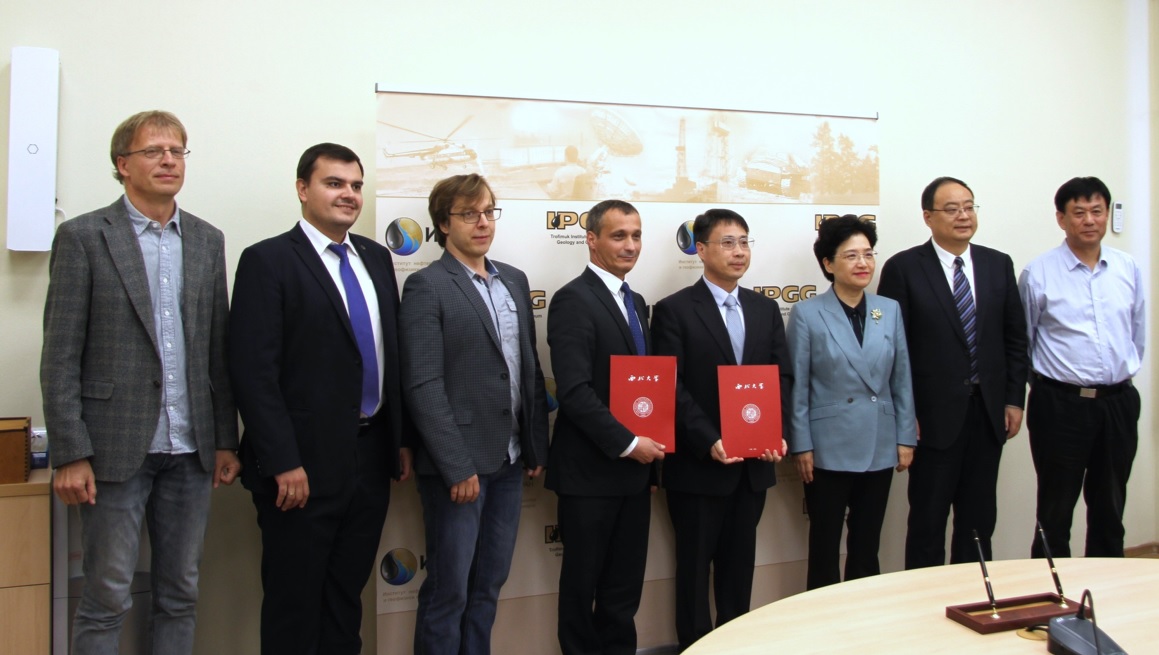
Signing of the scientific cooperation agreement with NWU. From left to right: D.V. Grazhdankin, M.A. Fomin, A.A. Duchkov, V.N. Glinskikh (IPGG SB RAS); Sun Qingwei (NWU); Xing Shanping, Wang Shusheng (People’s Government of Shaanxi Province), Zhang Xingliang (NWU)
Based on the results achieved, scientific collaboration with Northwest University has proved the most fruitful and NWU invited top IPGG researchers involved, to establish a new research center for studying Ediacaran (Vendian) biota. Cooperation is also developing with NWU's College of Urban and Environmental Sciences on studying chemical processes in coal mining waste dumps. Chinese colleagues also turn to the Institute for expertise on organic matter present in coal-waste rocks.
A major role in strengthening the scientific cooperation has been played by Dmitry Grazhdankin, head of the Precambrian Paleontology and Stratigraphy Laboratory at IPGG SB RAS. His research and expert competencies are in high demand in China. Professor Grazhdankin's contributions to scientific work has been acknowledged at the highest level: he was invited, in the group of foreign scientists, to a meeting with Premier of the State Council of the People's Republic of China Li Qiang, the second-highest authority. The meeting took place at the Great Hall of the People, the country's political, economic, cultural and diplomatic center. As an only representative from Russia, D.V. Grazhdankin was given a seat in the front row, which according to Chinese diplomatic protocol signifies the highest level of recognition of his contributions.
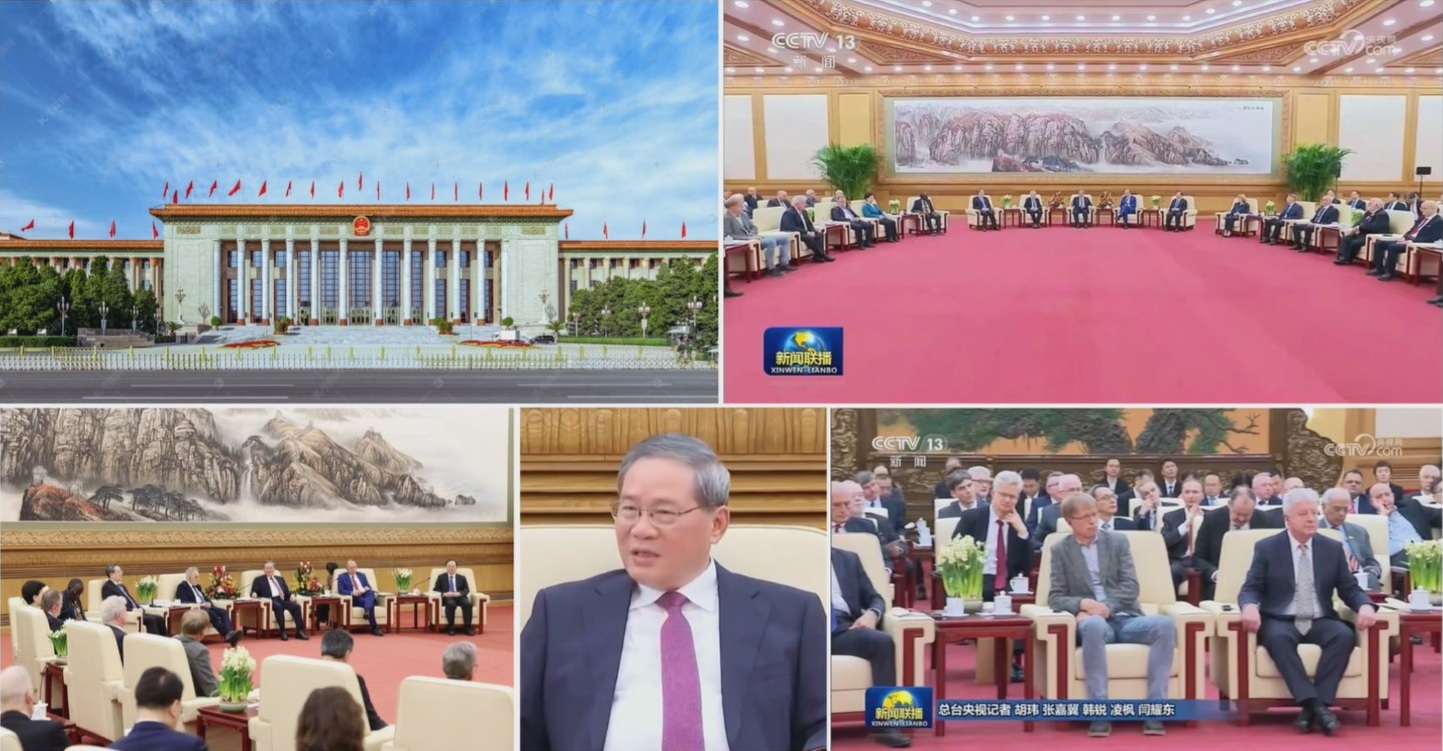
D.V. Grazhdankin at the meeting with Li Qiang (footage from China Central Television report, cctv.com)
IPGG SB RAS actively participates in the work of the Sino-Russian Association of Fundamental Sciences (SRAFS) which includes five Russian-Chinese centers (for Mathematics; Physics; Chemistry; Earth Sciences; and Life Sciences). The SIFR base opened in the ‘Yazhouwan’ technology city of Sanya, Hainan Island, already serves as hub for scientific research and conferences.
Together with representatives from Lomonosov Moscow State University, Dmitry Grazhdankin took part in a roundtable discussion where further plans for cooperation in Earth sciences were discussed. The proposals from the Chinese side were therefore supplemented by D.V. Grazhdankin, with due account of actual research directions of IPGG SB RAS.
It is planned that specialists from both countries will be engaged in numerous research lines. These include integrating existing hypotheses about the "Cambrian explosion" with facies, paleogeographic, and stratigraphic reconstructions (using examples from Eastern Europe, Siberia, and China); terrestrial-marine teleconnections in the Devonian (using examples from the Altai-Sayan folded region, the Western Tien Shan, and Northern China) and formation of ore minerals.
Another promising research topic is the formation of habitable conditions in the early Earth's evolution (using the example of the Lower Proterozoic Udokan Group in southern Siberia). Scientists will also investigate interactions between Cenozoic tectonic and climatic processes along the Tibetan Plateau – polar regions transect. A joint Russian-Chinese expedition to the Transarctic Mountains (Antarctica) is also planned, and D.V. Grazhdankin is elected as one of the coordinators for the expedition.
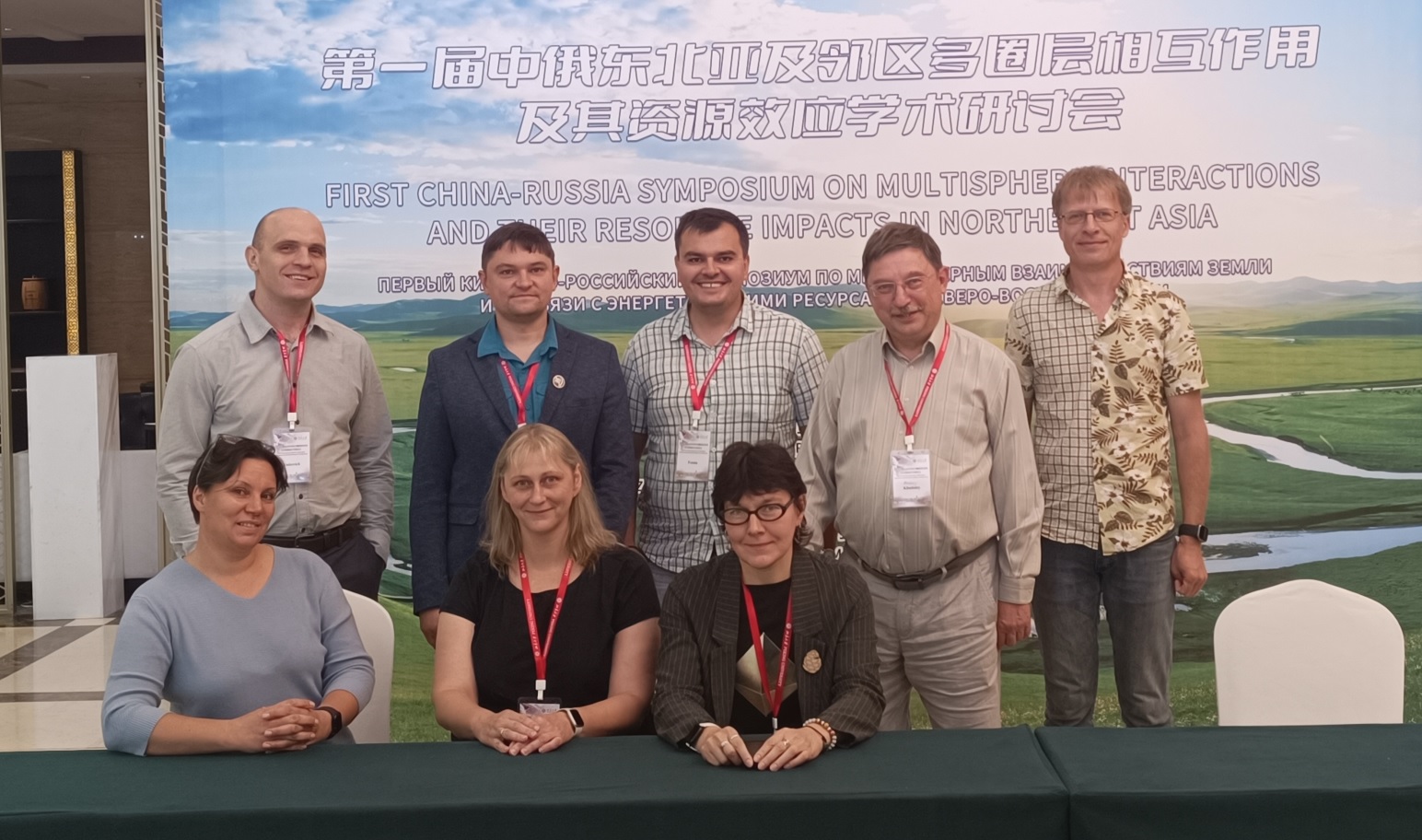
IPGG researchers as part of the Russian delegation at the First Chinese-Russian Symposium on Multisphere interaction and its impact on energy and mineral resources in Northeast Asia
As Dmitry Grazhdankin emphasizes, the association designed as a high-quality international platform for fundamental research and the training of qualified specialists has largely facilitated cooperation between Russian and Chinese organizations, both universities and academic institutes. Within the frames of SRAFS activities, the issue of simplifying the exchange of geological materials, including samples, is being resolved. Documents on this matter will soon be sent to the related ministries of Russia and China.
Currently, Russian and Chinese colleagues are planning to co-supervise PhD students in the English-language doctoral program at Peking University under the auspices of SRAFS. The application deadline for candidates is December 2026.
Moreover, the Russian Science Foundation and the National Natural Science Foundation of China (NSFC) have declared calls for applications open for the sixth international competition for Russian-Chinese research teams. The application deadline is April 27, 2026. The NSFC also annually announces competitions for foreign researchers (this year, the application deadline is March 20). Grant funds can be in the range from 200 000 to 800 000 yuan (from 2.3 to 9.2 million rubles, respectively).
In addition, an international field practice for students from both countries is planned within the frames of SAFR activities . This summer, students will be able to go on practice in tectonics and petrology (in the mountains of Northern China), as well as in sedimentology and paleontology (in Southern China).
Published by IPGG Press Service
Photos from the IPGG archive and courtesy of D.V. Grazhdankin