
Researchers from the Trofimuk Institute of Petroleum Geology and Geophysics SB RAS, Novosibirsk State University, and T8 Sensor Company performed fiber-optic sensing at the test site in Novosibirsk using a curved cable. The research results discussed at the 9th International Geological and Geophysical Conference and Exhibition "GeoEvrasia-2026. Geological Exploration Technologies – Science and Business" have received great interest both from scientists and industry professionals.
These results were presented by Sergey Yaskevich, PhD (phys.-math.), senior research scientist from the Laboratory of Dynamic Analysis in Seismology at IPGG SB RAS.
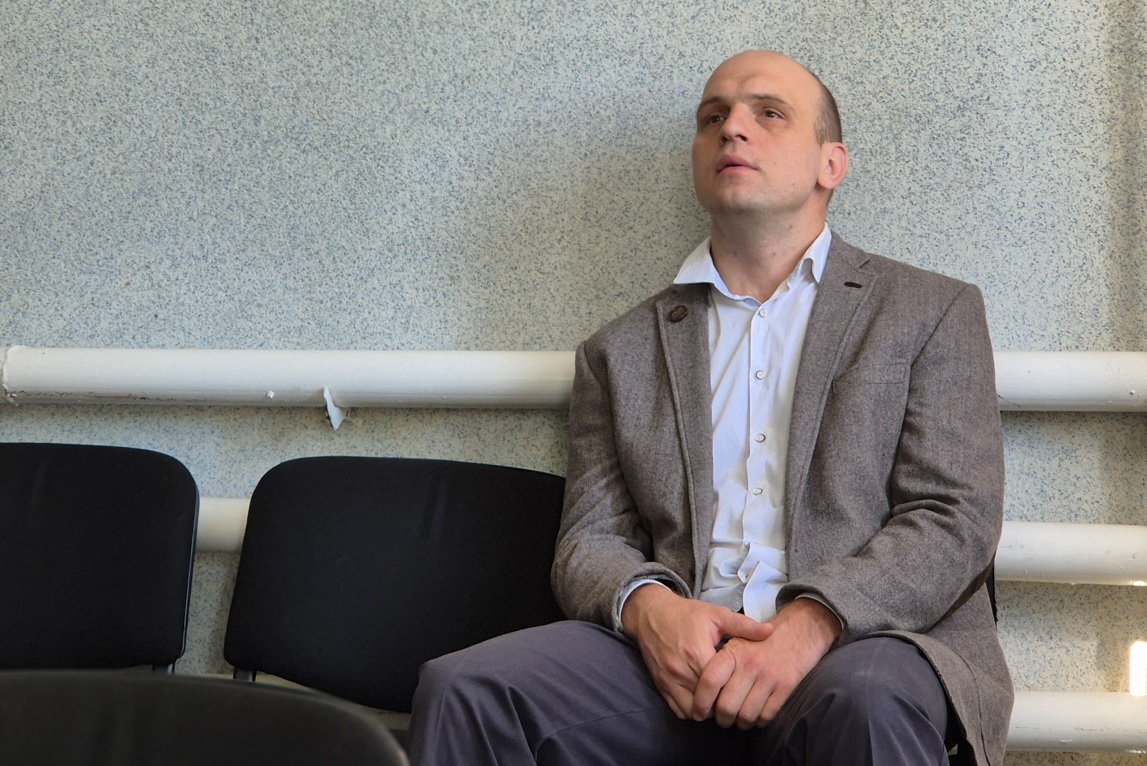
Sergey Yaskevich
Questions posed to Sergey Yaskevich about this innovation, and his answers
Q: What makes fiber-optic seismic sensing appealing to seismologists, and cables — so important in these measurements?"
A: Seismological techniques provide ground-motion data by recording seismic signals from natural and man-made sources, which requires dense spatial coverage of individual sensors deployed on the surface. Fiber-optic sensing technology developed relatively recently, referred to as distributed fiber-optic sensing, use the entire length of an optical fiber as a sensing element, which allows a marked densification of spatial sampling. In general the principle involves sending a pulsed coherent optical laser signal propagating along the fiber and measuring the naturally backscattered light. Its application for ground-motion detection is often referred to as distributed acoustic sensing (DAS) or distributed vibration sensing (DVS).
In seismic exploration and seismological observations, the multicomponent nature of the displacement field plays a significant role. Straight linear fiber-optic cables are primarily sensitive to strain along their longitudinal axis (axial strain). Fiber-optic sensing has therefore advanced primarily in areas where waves polarized or propagating parallel to the cable direction are most important. Fiber-optic systems have effectively revolutionized seismic data acquisition in many fields of application, in particular, vertical seismic profiling (VSP), since they take significantly less time that would have been needed to acquire the same survey using geophones because limited wellbore coverage of the geophone tool string would have required several movements of the geophone tool string to obtain a VSP of the entire wellbore
Q: Within a specific remit of cables, what is the matter of major concern in land seismic surveys?
A: Seismic surveys on the ground need to be capable of detecting timely vertical land displacements that are typically orthogonal (perpendicular) to the Earth’s surface. One known technological solution deploys cables made up of a straight core that is surrounded by multiple layers of helical wires; such a cable is called HWC (helically wound cable), while we propose an alternative solution.
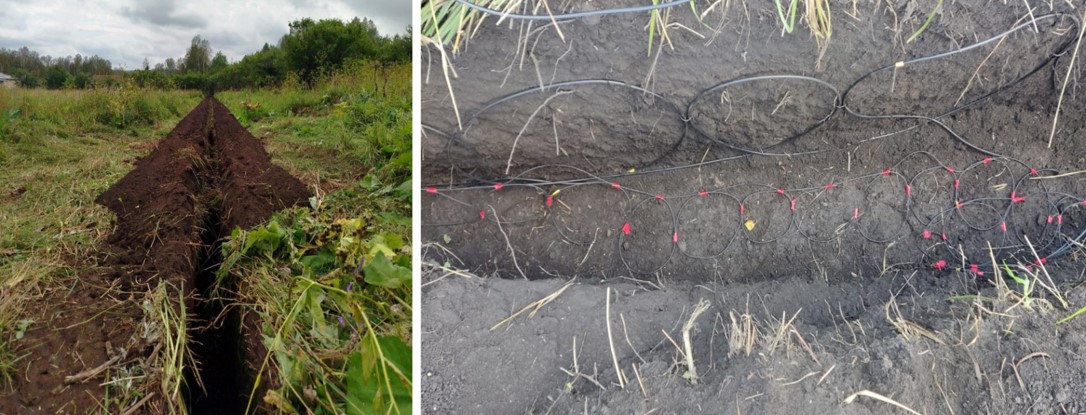
Laying the cables at the Klyuchi Test Site
Q: What experience was gained from the works performed at the test site?
A: We have tested the proposed novel method of laying fiber-optic cable which allows recording nearly vertically polarized waves. As part of the experimental work at the Klyuchi test site, we used trenching technique which enabled optical cable to be installed in the groove by fixing it onto its wall in two ways: laying it in loops and in a sinusoidal (snaking) pattern. By doing so we intended to implement a new cable layout configuration with higher sensitivity to predominantly vertically polarized seismic waves.
Q: How can you describe the results obtained?
A: In computer simulations performed by Ivan Boychuk, an MD student at NSU, sensitivity of the sinusoidal systems is shown to be higher. The difference in amplitude caused by transition from one type configuration to another was confirmed by the observations. The proposed system enabled vibration detection through recording predominantly vertically polarized waves. To this end, the Agidel interrogator kindly provided by the T8 Sensor company was extremely helpful.
Published by IPGG Press Service
Photos from the IPGG SB RAS archive (1) and courtesy of Sergey Yaskevich
Results of the authors’ early efforts in this research field are discussed in the article by: S.V. Yaskevich, D.R. Kharasov, P.A. Dergach, A.A. Duchkov, A.Yu. Zadoev, I.V. Boychuk, A.V. Yablokov “Fiber-Optic Interrogators: DAS or Not DAS? Field and Laboratory Testing”. Georesursy (Georesourses), 2026, vol. 28, no. 1, pp. 115-122 http://www.ipgg.sbras.ru/ru/publications/ibc/2026/grs-2026-1-115-122.pdf