
Petr Dyadkov, PhD (geol.-mineral.), head of the Laboratory of Natural Geophysical Fields at the Institute of Petroleum Geology and Geophysics (IPGG SB RAS) discussed in this interview its recent results and the interest gained from the international scientific community towards the Institute's research works.
Q: Petr Georgievich, your laboratory focuses primarily on investigation of geomagnetic anomalies and earthquake precursors. Which of the latest achievements do you consider the most significant?
A: We have completed a certain stage in the study of rigid blocks of the earth's crust determined from magnetic anomalies and earthquake hypocenters, with characterization of the seismic process in their vicinity. In particular, we analyzed data on hypocenters of seismic events (main shock and aftershocks) and distribution of magnetic field anomalies in the central and southern Lake Baikal. This allowed us to identify a number of aseismic structural features in the Earth's crust that spatially coincide with positive magnetic anomalies.
For example, such anomaly was discovered in southern Lake Baikal. The aseismic zone practically duplicate the contours of the magnetic anomaly. It’s worth nothing that all large earthquakes (M>5) were localized only along the boundaries of this anomalous body, including the Kultuk earthquake of August 27, 2008 with M w = 6.3. It has also been established that rigid bodies in the earth's crust affect significantly the parameters of both aftershock processes and precursors of large earthquakes.
Q: Are there any interesting results in tectonomagnetic anomalies, which is yet another direction of your lab research?
A: Our laboratory has developed a new method for detection of geomagnetic secular variation and the respective correction of tectonomagnetic data. This new technique is proposed for picking the secular variation component in the Earth’s main magnetic field recorded by precise measurements.
The new method is tested using data of yearly geomagnetic measurements at the geodynamic networks deployed in Gorny Altai (more than 30 repeat stations) and in the Lake Baikal region (more than 100 stations) which are ~120 km and ~400 km long, respectively. The results allowed us to reveal previously hidden tectonomagnetic anomalies that may be associated with earthquakes preparation and occurrence in these regions.
Q: You appear to regularly present your lab's findings at various conferences in Russia. What about any interest in our research works from international colleagues?
A: Yes, there certainly is some keen interest. In September 2025, together with Ivan Kulakov, Corr. member of the Russian Academy of Sciences, I took part in the Joint Conference of two international associations: the Association of Geomagnetism and Aeronomy (IAGA) and the Association of Seismology and Physics of the Earth's Interior (IASPEI). The event which was held in Lisbon, Portugal, was attended by 1250 scientists from 85 countries.
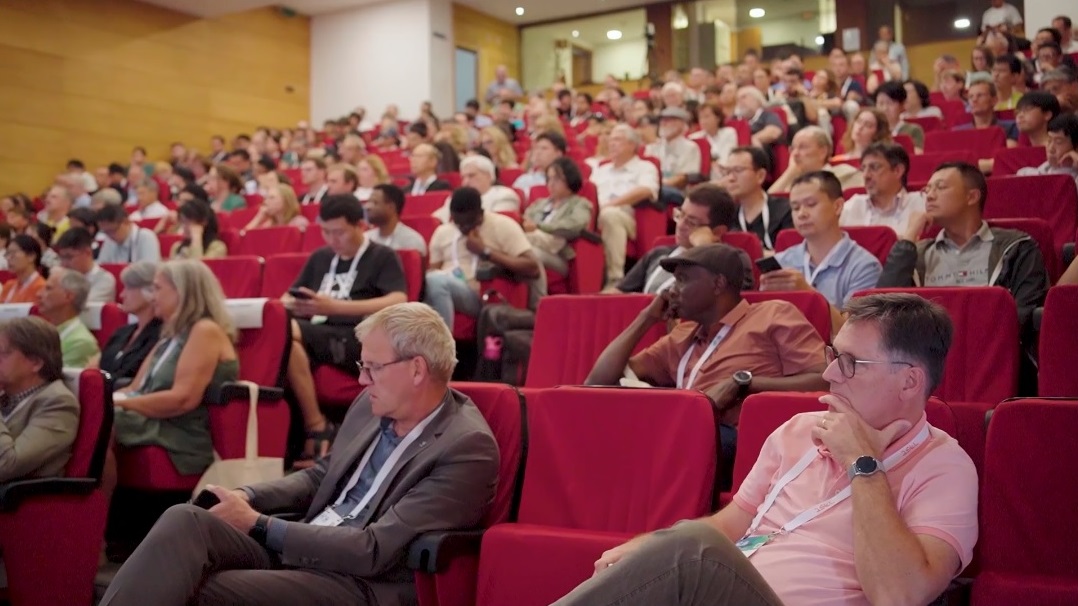
Photo: IAGA & IASPEI Conference Participants have familiarized themselves with some research results and findings of IPGG SB RAS
The session titled "Integrated modeling of magnetic, seismic, and other geophysical data for studying georesources, and relationships between structures, stress and seismicity” was opened with my presentation on rigid crustal blocks in the Baikal Basin inferred from the identified magnetic anomalies and hypocenters of large earthquakes, and characteristics of their precursors and postseismic effects. We also delivered a poster presentation on the methodology for identifying the parameters of secular variation based on precise geomagnetic data collected during geodynamic and seismic (tectonomagnetic) monitoring at special test sites (in Altai and Baikal regions).
Ivan Kulakov, now professor at the Skolkovo Institute of Science and Technology and simultaneously principal research scientist at IPGG SB RAS, also made several presentations on results of the Seismic Tomography Laboratory (IPGG SB RAS), specifically, research works conducted on Mutnovsky Volcano (Kamchatka) and in other regions.
Our international colleagues showed their sincere interest both in our presentations and research works of other Russian scientists. This attests to a high-level science in Russia, as well as to significant potential and importance of our research.
Published by IPGG Press Service
Photo courtesy of P.G. Dyadkov
The research works were financially supported by the R&D FWZZ-2022-0019 project of the Institute of Geophysical Research of the Siberian Branch of the Russian Academy of Sciences (IPGG SB RAS).