
The work which is currently in progress is conducted on the basis of science-industry collaboration approach, by Georgiy Mitrofanov, DSc (phys.-math.), principal research scientist at the Trofimuk Institute of Petroleum Geology and Geophysics (IPGG) SB RAS, and Evgeny Korytkin, a specialist at SakhalinNIPI Oil and Gas LLC. As a result, seismic facies analysis methods, an important tool for reservoir characterization, have been improved, thus allowing reducing exploration risks.
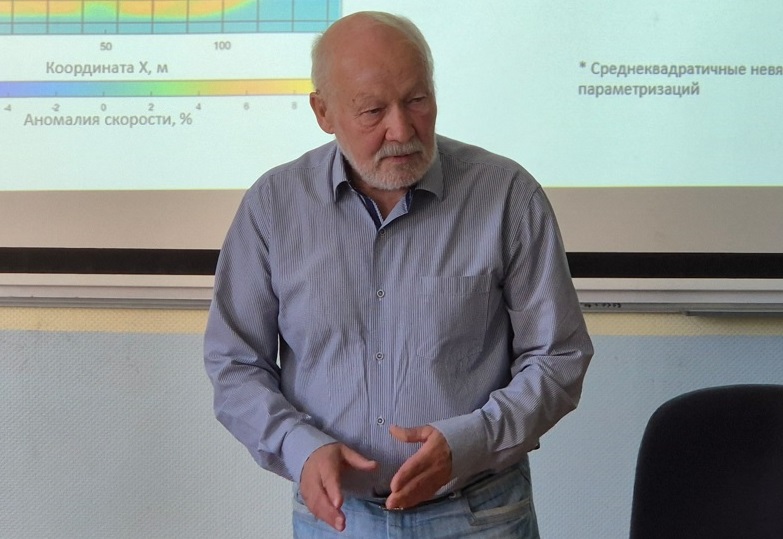
Georgyi Mitrofanov, DSc (phys.-math.), principal research scientist
What makes this methodology spot-on?
Classical methods of seismic facies analysis have their limitations, such as the complexity of processing large volumes of data and the need to manually evaluate seismic images and their characteristics for facies classification. Recently, geologists began to use machine learning methods such as clustering and classification for data interpretation and analysis, in order to minimize labor costs and improve the reliability of solved seismic facies analysis problems.
One effective mathematical tool used in solving these problems is the Bayesian classifier. Specialists from IPGG SB RAS and SakhalinNIPI Oil and Gas have improved through the integration with prior probability maps for each litho-classification.
In this new version, the algorithm generates facies expected for the area, helping to identify the best reservoir facies when associated to well and geological information. According to the researchers, this has helped increase the reliability of the predictions obtained.
Applications and prospects
Specialists already used the improved algorithm for the study of the test site at an oil- and gas- condensate field in the Orenburg region. Following the seismic facies analysis, successful reperforations of existing wells and production drilling were performed, confirming both the classification results and reservoir development concepts.
– Application of the improved Bayesian classifier algorithm to solving the problems of seismic facies analysis during the exploration and production phases, may significantly increase the reliability of the interpretation results, ― the researchers emphasized.
The proposed methodology would have allowed the prediction of reservoir potential before the appraisal well was drilled, thus ensuring the effectiveness of this approach in reducing exploration risks.
Scientists plan further research in this field with an aim to improve the accuracy of prediction of the reservoir properties of target horizons.
Published by IPGG Press Service
For reference
The work was supported by the scientific research funding project № FWZZ-2022-0017.
For more detail, please see the article by: Korytkin E.I., Mitrofanov G.M. (2025) Improving the accuracy of reservoir properties prediction using machine learning methods. Russian Geology and Geophysics, v. 66, No. 9, p. 1160–1169