
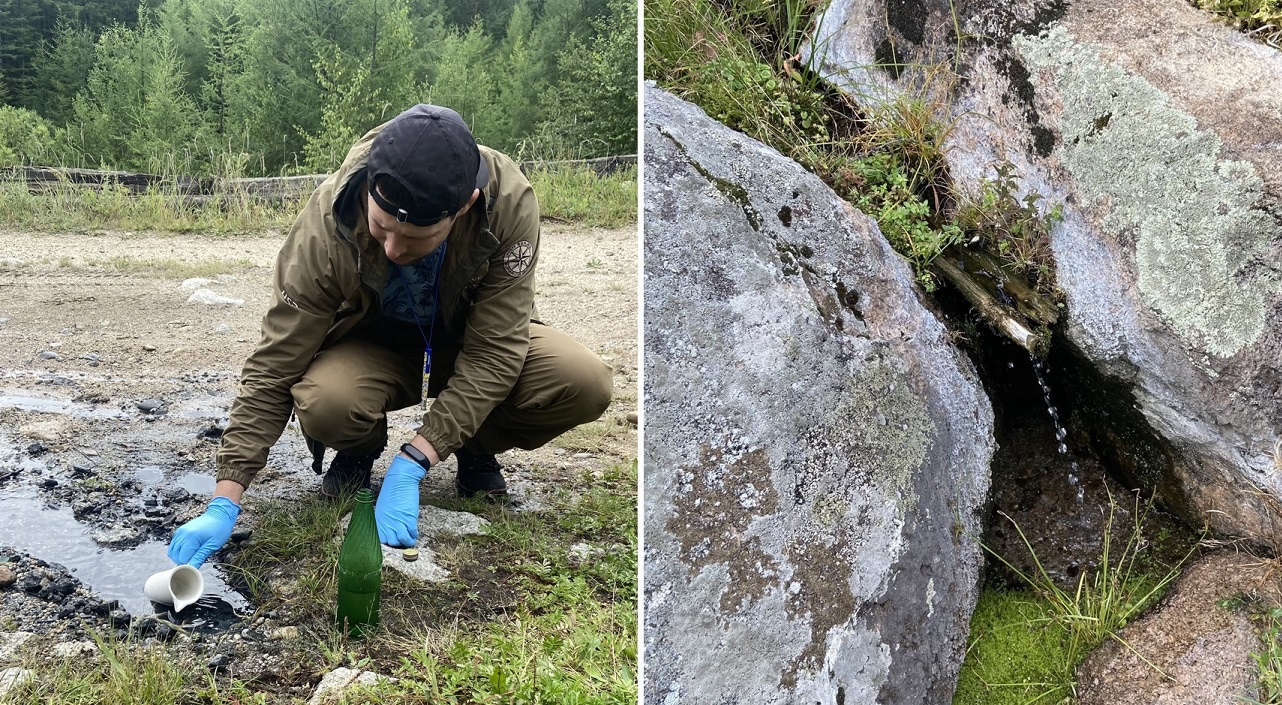
Valery Poturay, first author of the article, collecting samples; Urinsky thermal spring.
There are plenty of hot (hydrothermal) springs near Lake Baikal owing to the presence of the Baikal Rift Zone (BRZ) featuring a complex, transcrustal system of deep faults, with Lake Baikal sitting at the center. Fault zones like this are usually characterized by intricately linked seismic activity and hydrothermal circulation.
Hydrothermal waters are utilized for diverse applications, spanning renewable energy generation, agricultural heating, industrial manufacturing, heating homes in remote settlements. Hot springs have long been used by people for bathing, as such procedures are widely believed to have healing effect and perform recreational functions. And yet, the composition of organic matter of the water in great many springs remains incompletely understood, even though it may serve as a highly effective tool for monitoring aquatic ecosystems and identifying environmental pollution (e.g. from industrial waste). While some scientists believe that life on Earth originated in hot springs, knowledge of the composition of organic mixtures present in them would be extremely helpful in reconstructing the geological / environmental conditions under which the earliest life emerged. The lack of such data also prevents specialists from generating consistent evidence of health outcomes relating to hot spring water exposure.
Scientists from the Tomsk branch of IPGG SB RAS, together with colleagues, have determined the composition of organic substances from hydrothermal springs of the Baikal Rift Zone.
During the 2024 expedition, the authors collected samples from one thermal water well and 14 hot springs. The water temperature at the surface was in the range from 20°C to 76°C. Chromatographic analysis allowed identifying 211 organic compounds of various sizes, from small to fairly large molecules.
Among them, the largest portion (about 40% of the total) were saturated hydrocarbons — linear molecules consisting of carbon and hydrogen, a smaller one comprised aromatic hydrocarbons (compounds with a benzene ring) (21%) and esters (17% ). The total content of all organic substances did not exceed 0.7 mg per liter of water, which is characteristic of many groundwaters and indicative of the absence of anthropogenic pollution.
The authors paid special attention to polycyclic aromatic hydrocarbons (PAHs, consisting of two or more carbon rings) which are widely distributed in the environment where they have the potential to form carcinogenic and mutagenic diols (of both natural and anthropogenic origin) therefore extremely hazardous for human health. Based on the ratios of different substances within this group, their sources are inferred by the authors to be predominantly natural, i.e. formed as results of chemical reactions occurring in the Earth's crust. Moreover, their concentrations do not exceed safe levels.
"Most of the identified compounds are generally easily formed by the natural decomposition of ancient organic remains under high temperature conditions. In addition, bacteria play an important role, since the water temperature in the springs can be ideal for thriving of some thermophilic species capable to 'produce' organic compounds. We found virtually no anthropogenic sources of pollutants, thus declaring the purity of these waters, which provides good reasons for their balneological use. In the future, based on the obtained results we plan to develop a conceptual model of the formation of the chemical composition of thermal waters, to reveal the mechanisms of evolution of the 'thermal water–rock' system. This will allow predicting changes in the composition and properties of thermal waters, as well as technological risks during their exploitation (scale build-up, corrosion), and optimizing their use in energy, balneology and seismic monitoring," says Elena Zippa, PhD (geol.-mineral.), senior researcher at the Laboratory of Hydrogeochemistry and Geoecology, Tomsk Branch of IPGG SB RAS, and the project leader supported by a grant from the Russian Science Foundation.
The study involved researchers from several institutions, including Lomonosov Moscow State University (Moscow), the Institute of Natural Resources, Ecology and Cryology SB RAS (Chita), the Institute for Complex Analysis of Regional Problems FEB RAS (Birobidzhan), and the Dobretsov Geological Institute SB RAS (Ulan Ude).
Information source: RSF press service (https://rscf.ru/news/release/naydennye-v-goryachikh-istochnikakh-baykala-veshchestva-pomogut-otslezhivat-ekologicheskoe-sostoyani/)
Photos courtesy of Elena Zippa
Published by IPGG Press Service