
The research results of DSS (deep seismic sounding) investigations carried out in the eastern margin of the Archean Siberian Craton by joint efforts of researchers from IPGG SB RAS and the Altai-Sayan Branch and Seismological Branch of the Unified Geophysical Survey RAS will help locating mineral deposits.
Alexander Salnikov, DSc (geol.-mineral.), lead research scientist at the Laboratory of Geophysical Research and Regional Seismicity at IPGG SB RAS discussed the progress made to date.
What is the work content and geography of the research?
The Siberian Craton, with the Siberian Platform being its constituent part, is the oldest stable tectonic block forming the geological core of Northern Asia. It extends for millions of square kilometers between the Yenisei, Lena, and Anabar rivers and Lake Baikal.
The National Network of Geological and Geophysical Transects, Parametric and Superdeep Wells Program is currently being implemented in Russia with involvement of specialized providers of geophysical services, e.g. in the Far Eastern Federal District areas poorly explored by deep geophysical research.
In particular, seismic research was conducted on the reference 3-DV profile. The reference geological and geophysical profile which is the main element of the National Network, intersects several regional geo-structures (mineragenic provinces), thus providing a factual basis for structural studies of the Earth's crust and upper mantle based on advanced geological and geophysical methods. DSS studies were conducted in the middle section of the reference 3-DV profile laid through the Republic of Sakha (Yakutia), specifically, where the main basement structures of the SE Siberian Platform are located.
– The Precambrian basement is overlain here by the thick sedimentary cover, which makes the application of direct geological mapping methods not feasible, notes A.S. Salnikov. – In the meantime, the ancient continental basements are known to host major deposits of platinum group metals, nickel, chromium, diamonds, and other minerals. This is why the Siberian Platform basement and its deep structure have become a primary target for DSS research.
What has already been done?
Specialists have carried out seismic blasting operations in swamps, ponds, and quarries ranging from 1 to 3 meters in depth, using also vibroseis arrays to excite elastic vibrations, with ground responses recorded by specialized equipment.
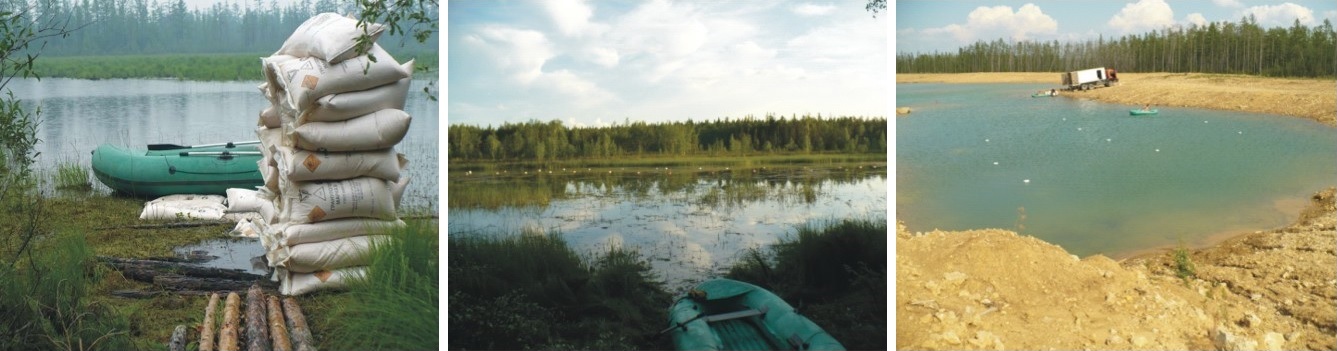
Preparations for blast-induced ground excitations
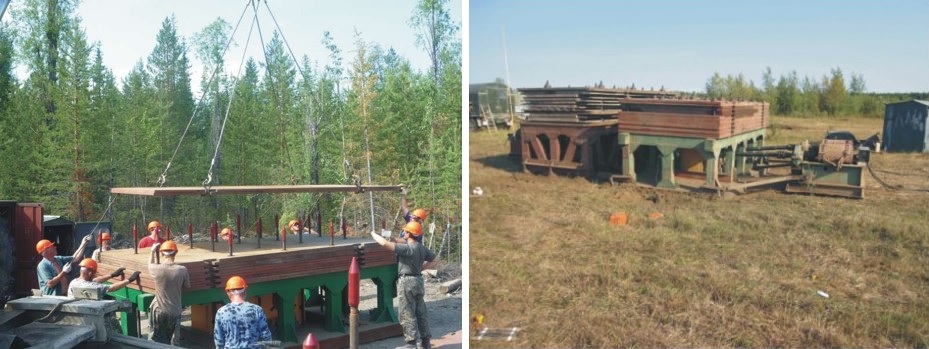
Installation of vibroseis arrays for blast-induced elastic vibrations
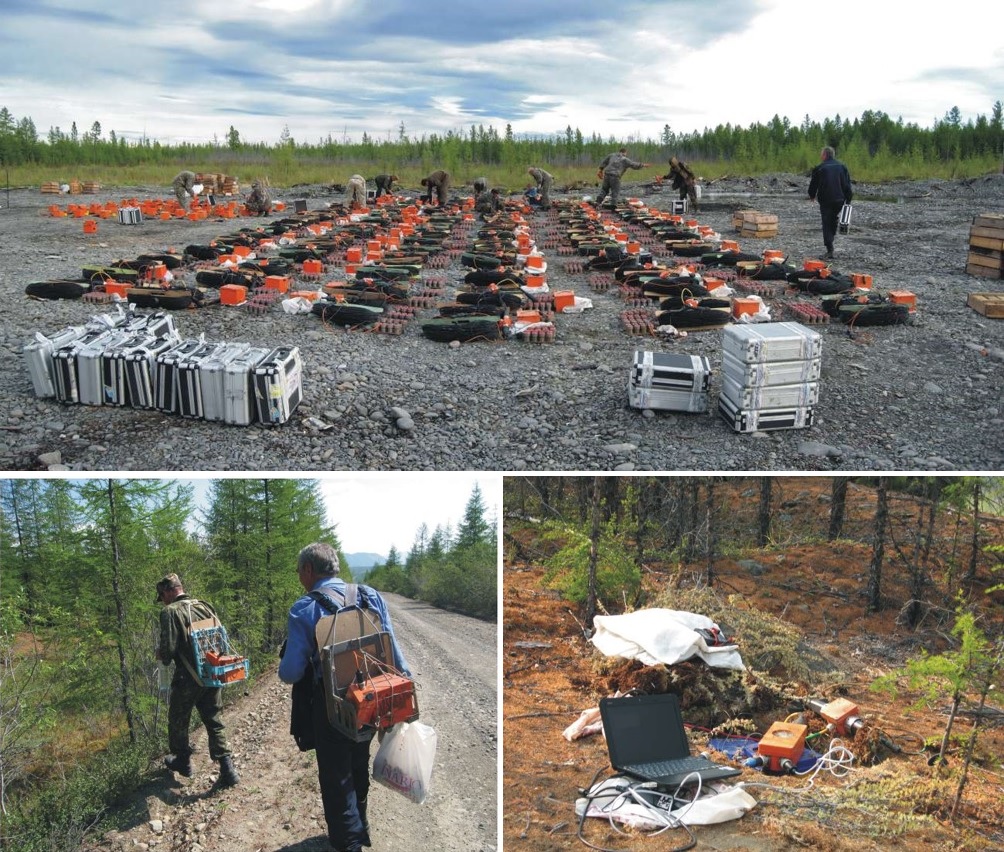
Elastic-wave propagation recording equipment in operation
Results of the seismic surveys carried out in the middle segment of about 800 km-long reference 3-DV profile provided for a thorough analysis of the recorded wave field produced by powerful explosive blasting sources of ground vibrations. This allowed constructing a deep structure model for the earth's crust and upper mantle of the SE Siberian Platform. In the future, the data interpretation will be carried out in greater detail.
– Until the present, crustal anomalies characteristic of granites and granitoids hosting gold-silver and polymetallic deposits have been our main focus, says A.S. Salnikov. – Now our efforts will be focused on identifying anomalies characteristic of basic and ultrabasic rocks. Specifically, they are considered the most important igneous hosts containing diamonds and many other valuable minerals.
Published by IPGG Press Service
Photos courtesy of the researchers
For reference:
This work was carried within Project FWZZ-2026-0050 "Seismogravity heterogeneities of the Siberian crust related to its stress state, seismicity indicators, and the development of interactive computational technologies for constructing multiscale structural-velocity seismic models" funded by the Russian Ministry of Education and Science (under State Contract No. 075-00609-26). The data utilized were provided by the Unique Large-Scale Research Facility "Seismic-infrasound monitoring complex of the Arctic permafrost zone and continuous seismic monitoring of the Russian Federation, adjacent territories, and the world" (URF SIA MAC) operated by the Geophysical Survey of the Russian Academy of Sciences.