
Researchers from the Trofimuk Institute of Petroleum Geology and Geophysics (IPGG) SB RAS (Novosibirsk) and Tomsk Polytechnic University (TPU) elucidated the potential and efficiency of this method.
According to researchers, significant reserves of methane trapped within the coal basins in Western Siberia, are comparable to those in conventional hydrocarbon deposits. The idea of methane extraction from coal seams was first expressed by an outstanding Russian scientist D.I. Mendeleev back in the late 19th century. This can be implemented using underground coal gasification (UCG) method.
Due to simplicity of the principles of fuel gasification using wood to fuel a generator, gasifiers were a common sight to see attached to the backs of cars, trucks, and tractors during WW2 – the implements that helped the national economy to keep afloat in the Soviet Union at that time.
In the post-war years, large industrial gas plants built in the USSR allowed switching to central supplies of high-calorific gas to the consumers. However, coal-based gas production gradually ceased to exist largely due to giant gas fields discovered in the mid-20th century in northern West Siberia which entailed gas supplies at long distances through large pipelines.
Specialists from IPGG SB RAS note that nowadays interest in underground coal gasification has dramatically increased in virtually all major coal-producing countries worldwide.
This method turns organic materials into a gas mix called syngas by heating them up to 2000°C with a controlled amount of oxidizer (oxygen, air, water vapor, carbon dioxide, or a mixture thereof) which is injected into the coal seam through an injection well. Finally, the second well (producer) produces generator gas. When reaching the surface, the generator gas cools and is purified from suspended solid particles (with the condensation of coal-tar resin particles).
– The advantage of this process is that it enables exploitation of unminable deep coal seams, including those containing high ash yield and thin profiles, scientists say. Moreover, there is no significant direct influence of the gasification process on the stability of the surrounding rocks, thus allowing preserving surface layer and minimizing environmental impacts.
With millions of wells drilled in Western Siberia, the available infrastructure can be used for underground coal seam gasification. The information on the maceral composition (source material) and the level of coal catagenesis is critical for cost efficiency of these works.
Why are macerals so important?
Macerals are origin microconstituents containing mineral impurities in varying concentrations; they are formed from various plant organs or tissues and directly determine technological, thermal, and chemical behavior of coals.
For example, coal grades Б and Д (early stages of mesocatagenesis) are low in methane. Although significant amounts of methane are present in anthracite coal seams, coalbed methane resources cannot be extracted effectively and quickly due to its high density and extremely low permeability. Coals intermediate between brown coal and anthracite are the most promising for methane extraction.
Coal grades richest in gas are Г, Ж and К (middle stages of mesocatagenesis) are composed primarily of lustrous and semi-lustrous coals (vitren and claren) dominated by vitrinite macerals. As an example, the methane-richest coal basins (Kuzbass, Pechora, and Karaganda) are characterized by coals dominated by these macerals, transformed to middle catagenesis grades. These coals are found in deep-seated Jurassic deposits in the southeast of the West Siberian megabasin (areas of Tomsk and Novosibirsk regions). Over 100 samples of Upper and Middle Jurassic coals (Vasyugan and Tyumen formations) were studied at IPGG SB RAS and Tomsk Polytechnic University, to determine their maceral composition.
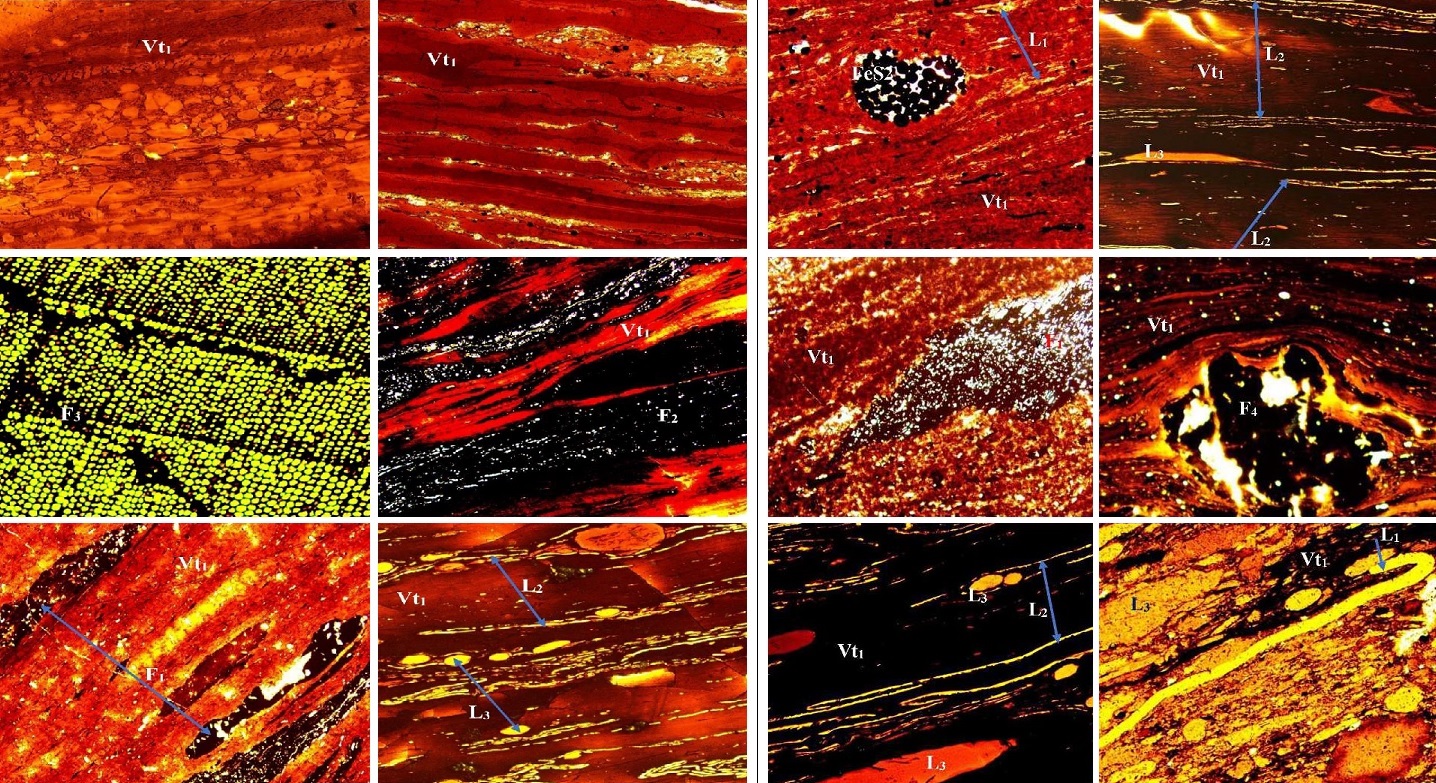
Maceral groups in coals of the Tyumen Formation (left) and Vasyugan Formation (right) under a microscope. Vitrinite group: Vt1 – collinite; Vt2 – telynite. Inertinite group: F1 – semifusinite; F2 – macrinite; F3 – fusinite; F4 – sclerotinite (funginite). Liptinite group: L1 – sporinite; L2 – cutinite; L3 – resinite
Specifically, it was established that the studied coals formed under fairly identical facies conditions. Their source material was the remains of higher plants, including tree trunks, branches, stumps, and roots. Microscopic studies revealed that these plants grew in a warm, humid climate, in peat bog conditions.
Although many studies have been conducted on coalbed methane over the past decades, there have not been found many ways to exploit it. Researchers believe that their findings will be in the greatest demand once natural gas reserves are depleted.
Published by IPGG SB RAS Press Service
Illustrations curtsey of researchers
Reference
This work was funded by Project No. FWZZ-2026-0043 of the Basic Research Foundation program.
For more details, see the article by: Fomin А.N., Lobova G.А. – Maceral composition of Middle and Upper Jurassic coals in the Southeast of the West Siberian megabasin// // Russian Geology and Geophysics – 2026 (in press).