
A series of expeditions aimed at studying the formation mechanisms of thermal springs in Transbaikalia has been accomplished by scientists from Tomsk, Ulan-Ude, and Birobidzhan. This year, the fieldworks were conducted in the Tunka Valley and the North Baikal District. The analyzed data on twenty springs across the vast Baikal Rift Zone obtained over three years attest to long lasting thermal water-rock interactions. Additionally, researchers gained insight into the formation of the chemical composition of thermal waters and the controlling processes, including the co-occurring sulfur oxidation and reduction. The study was funded by the Russian Science Foundation (Project No. 24-77-10035).
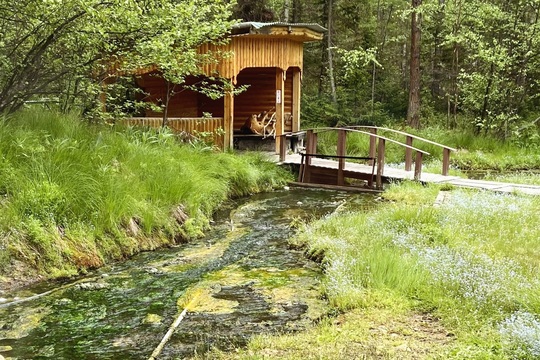
Researchers from IPGG SB RAS, the Dobretsov Geological Institute (SB RAS, Ulan-Ude), and the Institute for Complex Analysis of Regional Problems (FEB RAS, Birobidzhan) collected a series of samples of thermal waters (and rocks) from balneological resorts in the Tunka Valley (Nilova Pustyn, Zhemchug, and Arshan) and the North Baikal District (the Dzelinda and Khakusy health resorts, as well as the Kotelnikovsky spring). Analyses of these samples provided data on the bulk chemical composition of the waters including micro- and macro-elements, organic matter content, and reduced sulfur forms, as well as the isotopic composition of oxygen, hydrogen, carbon, sulfur, and nitrogen, including radioactive carbon and hydrogen isotopes.
The experience and knowledge gained over three years of research allowed scientists to move from describing the chemical composition of waters in individual thermal springs to constructing a comprehensive conceptual model of hydrotherms formation in the Baikal Rift Zone. This model is based on physicochemical calculations and the scientific concept of the geological evolution and self-organization of the "water-rock" system, a theory pioneered by professor S.L. Shvartsev, a renowned Russian hydrogeologist. This concept is basically grounded on continuous water interaction with the water-bearing rocks: during this process, it continuously dissolves primary rocks and forms new secondary minerals, thereby altering the water's own composition, through its interaction with the rock.
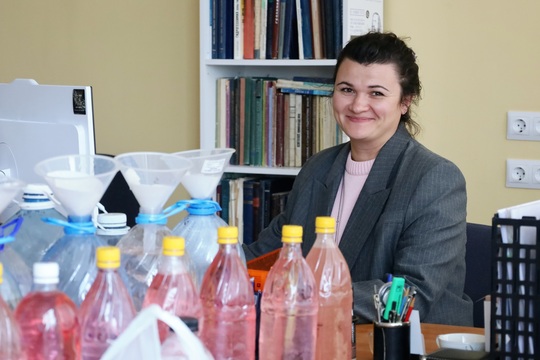
Elena Zippa
"Water of atmospheric origin (precipitation) penetrates deep into the rock and heats up at depth. As it moves from the recharge zone (sites favorable for the percolation of groundwaters and atmospheric precipitation deep into faults) to the discharge zone (sites of its showing up on the surface), the water dissolves primary minerals, accumulating chemical elements and altering the geochemical environment. Hence, favorable conditions are created for the formation of secondary minerals; these form when the concentration of chemical elements reaches the saturation limit. Gases also enter the system during this process. The presence of calcite, celestine, and chlorites indicates that the thermal water–rock system has been active for a prolonged period," explained Elena Zippa, PhD (geol.-mineral.), project leader and senior researcher at the Laboratory of Hydrogeochemistry and Geoecology, Tomsk Branch of IPGG SB RAS).
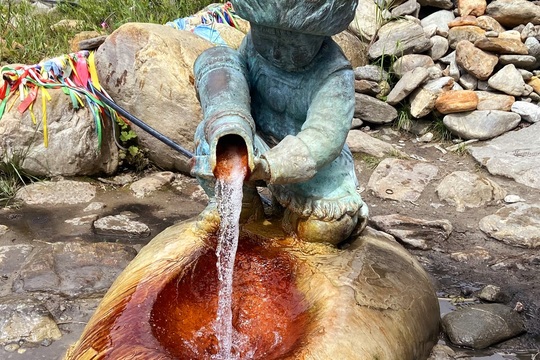
This qualifies thermal water to be not a random mixture of dissolved salts, with its unique composition resulting from the geological processing within the complex system every component of which plays a formative role. Sulfur, for instance, is crucial to the geochemical processes. Researchers have confirmed the simultaneous occurrence of two opposing processes: the oxidation of sulfides into sulfates at depth—at temperatures of 100–150°C or higher—and the bacterial reduction of sulfates into hydrogen sulfide near the surface. The presence of hydrogen sulfide determines the therapeutic profile of a thermal spring. Understanding its origin—whether it dissolves as a gas rising from depth or is actively produced by bacteria near the surface—is essential for assessing the stability of the water's chemical composition and the prospects for developing health resorts.
Scientists plan to conduct a detailed study of dissolution and precipitation processes within the water-rock system; this will help clarify how water composition changes through interaction with the host rock. They also aim to investigate the role of free gases and their influence on water-rock interactions and the bulk composition of thermal waters.
Source: Press Service of the Tomsk Scientific Center, Siberian Branch of the Russian Academy of Sciences (TSC SB RAS) (https://www.tsc.ru/ru/news/nw_003401.html)
Photos courtesy of researchers and TSC SB RAS Press Service.