
In collaboration with Novosibirsk State University (NSU) and the NSU Artificial Intelligence Center, scientists from IPGG SB RAS and specialists from T8 a leading Russian telecommunications and fiber-optic equipment manufacturer, primarily advanced fiber-optic sensing technology for geophysics and infrastructure monitoring, deployed an experimental monitoring network by conducting an experiment using a fiber-optic communication line on the university campus. The team tested whether an existing fiber-optic cable could function as an AI-enhanced distributed vibration sensor capable of discerning environmental events. Future prospects concern transition of this technology into active industrial use cases and urban applications (e.g. real-time monitoring for railways, industrial plants, pipelines, and urban environments).
The project utilized specialized hardware Dunay whose key component is an interrogator (provided by T8) connected to an active fiber-optic telecommunication line on the NSU campus. Coupled with AI algorithms, the fiber-optic line successfully records and automatically categorizes vibrations (based on analysis of characteristics of the backscattered signal) caused by passing vehicles, walking pedestrians, and nearby excavation or construction work.
The pilot project utilizes a 4.3-km-long fiber-optic line laid within the Novosibirsk Scientific Center, connecting Novosibirsk State University (NSU) and Aadempark (Technology Park of Novosibirsk Akademgorodok). By detecting vibrations with approximately 10 m resolution, the line effectively functions as an array of around 400 distributed observation points using Distributed Acoustic Sensing (DAS) technologies, which transform standard, pre-existing telecommunication fiber cables into thousands of continuous vibration and seismic sensors. — One can connect a specialized device to existing telecommunication lines, to utilize the buried fiber-optic cable as a distributed sensor, without having to lay new sensors, ― explained Pyotr Dergach, senior researcher at NSU and researcher at IPGG SB RAS.
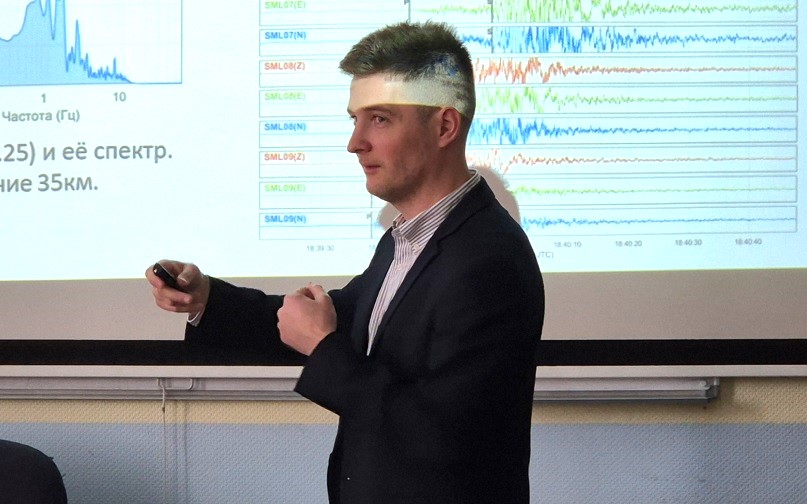
P.A. Dergach
The resulting data are transmitted to the AIC server (NSU), where machine learning (ML) algorithms categorize the recorded vibration signals. The system allows recognizing various events, for example, the passage of a car, a pedestrian, or underground works. For each detected event, the time and approximate place of its occurrence are determined, with the information being displayed in the system interface.
Depending on the task, fiber optic networks can be used for detecting perimeter intrusions, for continuously monitoring and controlling technical conditions of buildings engineering structures, as well as for traffic monitoring applications. Changes in the vibration background and the nature of vibrations may indicate unusual loads, changes in operating conditions, or equipment malfunction. This opens up the possibility of using the fiber optic line as a tool for early detection of anomalies, and enhancing the infrastructure condition monitoring.
One specific application of the technology is seismic monitoring. A distributed fiber-optic sensor can detect seismic signals and determine their characteristics, as well as the location of detection along the line. Importantly, the fiber-optic system need not entirely replace traditional seismometers; equally, its data may complement readings from discrete sensors and, owing to distributed measurements, enable enlargement of the monitoring area.
— The system receives a continuous stream of vibration signals; artificial intelligence identifies the characteristic signatures of various events within this stream, thus allowing detecting various events and their approximate location, ― explained Alexey Redyuk, leading researcher at the AI Center and Head of the Laboratory of Photonics and Machine Learning Technologies for Sensor Systems at NSU.
The project participants include specialists from NSU, IPGG SB RAS, the NSU’s Artificial Intelligence Center, and T8 utilizing its interrogator and assisting in its coupling with the telecommunication line and in data collection, while the university team is responsible for server infrastructure, software, visualization, and data processing algorithms. For comparison of the distributed fiber sensor results with readings from traditional point sensors, the data collection process is implemented jointly with Industrial Monitoring company. All equipment used in the experiment—including the Dunay interrogator—was integrated into the existing vibration monitoring system of the NSU campus, which was developed by the NSU Advanced Engineering School team including teachers and students.
— We are testing the concept of reusing existing telecom infrastructure. While dedicated sensor lines can be installed for monitoring systems, urban environments already contain a massive underground telecom fiber-optic cables that could potentially serve as distributed sensors, ―noted Pyotr Dergach.
DAS technology relies on analyzing light backscatter within an optical fiber. An interrogator sends short laser pulses into the fiber, while a small fraction of the light scatters back due to the fiber's inherent inhomogeneities. When physical forces like vibrations, acoustic waves, or mechanical strains interact with an optical fiber, they slightly distort its structure. Analysis of these changes will provide data on dynamic fiber strain at various points along the line and to locate the distortion. This approach is already being explored globally for monitoring roads, bridges, pipelines, railways, and other linear infrastructure.
The technology does have limitations. In certain respects, traditional seismometers may offer superior sensitivity, whereas the performance of a fiber-optic sensor is largely dictated by the installation method and the mechanical coupling of the sensing fibers with the surrounding environment. For instance, poor ground contact, fiber slack, or cable routing through manholes may impair vibration detection efficiency. However, the distributed nature of the measurements and the ability to utilize existing infrastructure allow partially counterbalancing these limitations.
Initial data have already been collected, and developers are now assessing the accuracy with which the algorithms can identify various events from optical fiber vibrations. The next step involves expanding the dataset and testing the system under diverse conditions. Once the results prove viability of the approach, the team plans to proceed to further trials at urban and industrial sites, where existing fiber-optic networks can simultaneously serve both data transmission and environmental monitoring purposes. Ultimately, the technology aims to support carbon emission reduction initiatives by enabling more efficient traffic flow management and promoting sustainable transportation choices through data-driven urban planning decisions.
Photo from the IPGG SB RAS archive
Source: NSU Press Service (https://www.nsu.ru/n/media/news/nauka/optovolokonnuyu-liniyu-svyazi-prevratyat-v-set-datchikov-dlya-monitoringa-obektov-infrastruktury/)